
We Deliver Directly To Your Door



Description
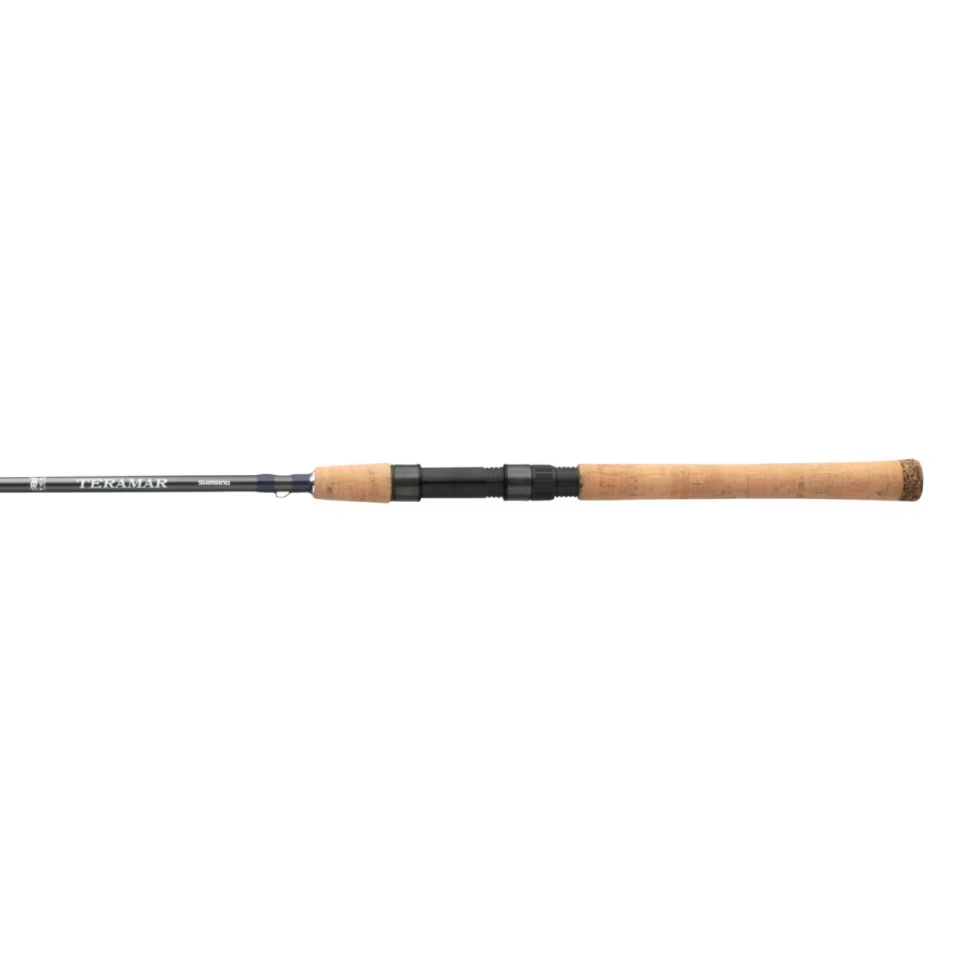
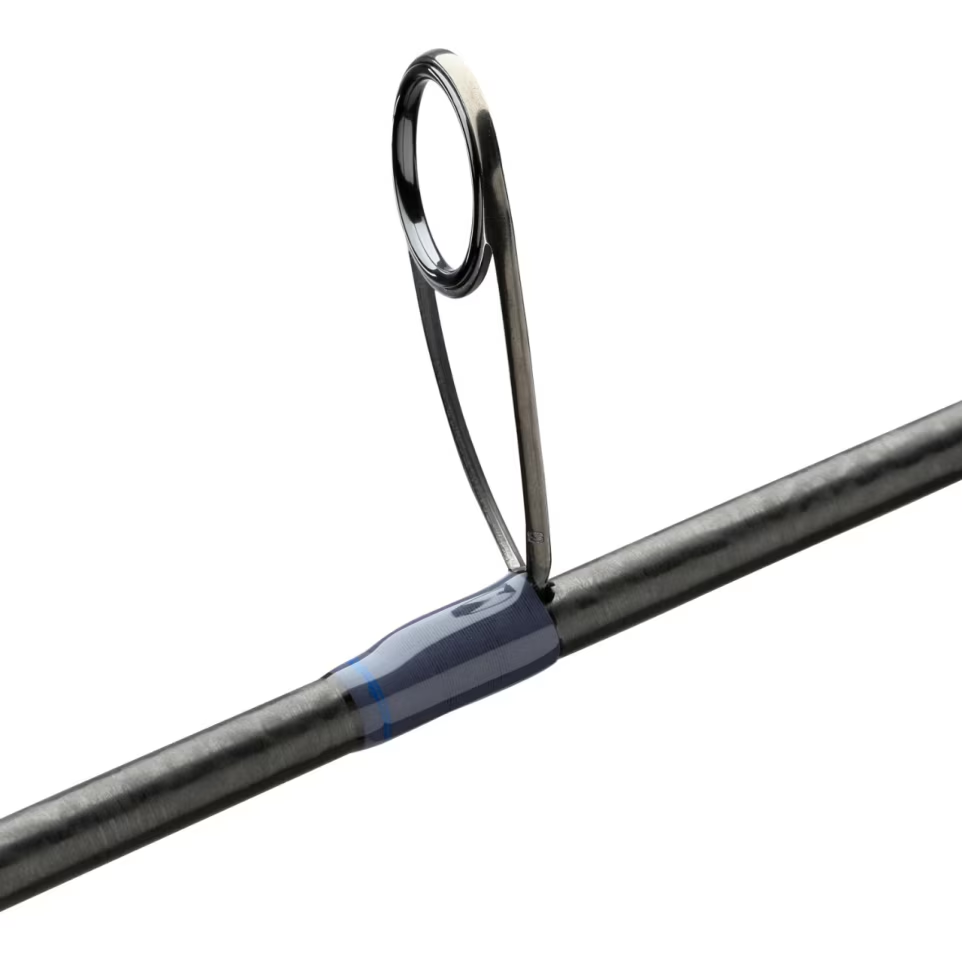
SHIMANO TERAMAR SE SPINNING INSHORE ROD
Built for Demanding Inshore Fishing

Confidence is often created before the first cast is made. It can be established through balanced equipment, dependable construction, controlled power, and a rod that feels natural throughout a long day on the water. For anglers who spend their time pursuing inshore species around flats, grass lines, docks, passes, mangroves, jetties, and coastal structure, those qualities can make every fishing session more productive.
The Shimano Teramar SE Spinning Inshore Rod has been developed around that demanding environment. A combination of responsive construction, practical inshore performance, and Shimano engineering is brought together so that casting, lure control, hook setting, and fish fighting can be handled with greater confidence.
Rather than being designed for only one fishing scenario, the platform is intended to provide versatility across a broad range of coastal techniques. Soft plastics can be worked around structure. Jigs can be presented along current breaks. Live-bait presentations can be managed with sensitivity. Topwater lures can be cast across productive flats. Furthermore, enough responsiveness can be provided for anglers who prefer precise lure manipulation without sacrificing the lifting power needed when a strong fish turns toward cover.
Because inshore fishing can change rapidly, versatility is especially valuable. Calm conditions can suddenly become windy. Clear water can become turbulent after a tide change. A productive shoreline can be replaced by deeper structure within the same trip. Consequently, equipment that can adapt to changing conditions can be extremely useful.
A Purpose-Built Inshore Fishing Platform
Inshore fishing places unusual demands on tackle. Long casts may be required, while accurate placement can be equally important. Light presentations sometimes need to be delivered delicately, yet a powerful fish may need to be controlled immediately after the strike.
For that reason, a balanced rod is essential.
The blank is designed to provide a useful combination of sensitivity and practical power. Subtle lure movement can be felt, while contact with bottom, vegetation, structure, or a tentative bite can be detected more readily. At the same time, the rod can be loaded during a fight so that pressure can be maintained as the fish changes direction.
A spinning configuration also provides a familiar platform for a wide variety of inshore techniques. Spinning reels can be paired naturally with lighter lines and smaller lures, while the open spool design allows casts to be made efficiently without requiring the angler to manage a casting spool.
That versatility makes the rod suitable for both experienced coastal anglers and those building a dependable inshore setup.
Responsive Blank Performance
Sensitivity Where It Matters
Sensitivity is one of the most valuable characteristics in an inshore rod. Many strikes are not dramatic. A fish may simply add weight to the lure, move sideways, or make a subtle tap that can easily be missed when the equipment does not transmit information effectively.
A responsive blank can help those changes become more noticeable.
Bottom contact can be distinguished more easily. Lure movement can be monitored with greater awareness. Vegetation can be identified as a lure passes through it. Moreover, subtle changes in pressure can provide useful feedback during a retrieve.
That information can improve decision-making.
Instead of relying entirely on sight, anglers can use the feedback transmitted through the rod to understand what is happening beneath the surface. As a result, lure presentations can be adjusted more deliberately.
Controlled Power
Sensitivity alone, however, is not enough for serious inshore fishing.
A fish that appears manageable in open water can become difficult when structure is nearby. Mangrove roots, dock pilings, rocks, oyster beds, vegetation, and submerged timber can all provide escape routes.
Consequently, useful power needs to be available when it matters.
The blank is intended to provide controlled resistance as pressure is increased. During a fight, the rod can help absorb sudden surges while maintaining pressure on the fish. At the same time, the angler can work the fish away from potential hazards.
This balance between responsiveness and strength is one of the most important characteristics to look for when selecting coastal tackle.
Designed for Casting Efficiency
Accurate Lure Placement
Inshore fishing is frequently a game of angles.
A lure may need to be placed beside a mangrove edge rather than several feet away. A jig might need to land directly beside a dock post. A soft plastic could be presented along the edge of a grass flat. Meanwhile, a topwater lure may need to cover a long stretch of shoreline.
Casting efficiency therefore becomes extremely important.
A well-balanced spinning rod can make repeated casts feel more controlled. When the equipment works naturally with the angler’s casting motion, less unnecessary effort may be required.
That becomes increasingly noticeable during extended fishing sessions.
Long-Range Presentations
Open flats and expansive shorelines can require distance. Feeding fish are not always positioned close to the boat, and wary species can become difficult to approach when water clarity is high.
Accordingly, casting distance can become a valuable advantage.
The rod can be used with appropriately matched spinning tackle to deliver a variety of lure styles across productive water. Soft plastics, jigs, plugs, spoons, and other compatible presentations can be incorporated depending on the selected model specifications and fishing conditions.
Longer casts can also allow anglers to cover more water without moving the boat as frequently.
Versatility Across Inshore Techniques
Soft Plastic Fishing
Soft plastics remain among the most adaptable presentations available to coastal anglers.
They can be rigged in multiple ways and presented around grass, current seams, docks, channels, flats, and deeper edges. Their relatively compact profiles can also be useful when fish are feeding on smaller forage.
A responsive spinning rod can make these presentations easier to manage. Subtle movements can be imparted through the rod tip, while contact with the bottom can be monitored during a controlled retrieve.
When a fish picks up the bait, pressure can then be applied through the blank as the hook is driven home.
Jig Fishing
Jigs are frequently used when current, depth, or structure makes precise presentation important.
A jig can be allowed to fall through the water column, bounced along the bottom, retrieved steadily, or manipulated with short rod movements. Each method requires the angler to understand where the lure is positioned.
Feedback from the rod can help provide that awareness.
The angler can monitor changes in resistance and distinguish between different types of contact. Furthermore, controlled blank response can help keep the lure working within the intended strike zone.
Topwater Presentations
Few inshore techniques are as visually exciting as topwater fishing.
Explosive surface strikes can occur around shallow flats, grass edges, points, and shoreline structure. Yet successful topwater fishing is not simply about casting a lure and retrieving it.
Cadence matters.
Pauses, twitches, directional changes, and speed adjustments can all influence how a lure behaves. A responsive rod can assist with these movements by transferring deliberate inputs to the lure.
When a fish strikes, maintaining composure becomes equally important. The rod can then be used to maintain tension while the fish begins its first run.
Live-Bait Presentations
Live bait can require a different approach.
The bait may need to remain active, natural, and properly positioned within the strike zone. Excessive movement from the rod can sometimes work against that objective.
A balanced spinning setup can therefore be useful because subtle control can be maintained without making the presentation unnecessarily complicated.
When the bite arrives, the angler can transition from presentation to fighting pressure with greater confidence.
Built for Coastal Environments
Flats
Shallow flats are among the most productive inshore environments, particularly when tides bring baitfish and predators into feeding areas.
However, flats can also demand long casts and careful lure control.
A versatile spinning rod can be used for searching large areas with artificial lures while maintaining the sensitivity needed to identify subtle strikes.
Mangroves
Mangrove shorelines create excellent ambush points for predatory fish. They also create one of the most demanding environments for anglers.
A missed cast can place a lure directly into branches. A hooked fish can immediately turn toward cover.
Therefore, accuracy and controlled power are both valuable.
With appropriate reel and line selection, a properly matched spinning rod can be used to place lures close to productive cover while providing the leverage needed after a strike.
Docks and Piers
Artificial structure frequently concentrates forage and predatory fish.
Docks, pilings, seawalls, and piers can provide shade, current breaks, and ambush opportunities. Because fish can use those structures to their advantage, the angler often needs to respond quickly.
Once a strike occurs, pressure must be managed carefully.
The rod can be used to direct the fish away from immediate hazards while maintaining enough flexibility to reduce sudden slack.
Jetties and Rocky Structure
Jetties introduce another set of challenges.
Current can be stronger. Casting angles can be awkward. Lures may need to be worked around rocks, deeper water, and moving bait.
A versatile spinning setup can provide the flexibility needed to adapt to these conditions without forcing anglers to change equipment every time the environment changes.
Ergonomic Handling for Long Fishing Sessions
Balance and Comfort
Inshore fishing often involves repetition.
Cast after cast may be made throughout an entire tide. Lures can be worked continuously. Fish may be searched for over large areas. Consequently, overall tackle balance can have a meaningful effect on comfort.
A properly paired spinning reel can help create a balanced setup.
When the rod and reel complement one another, unnecessary strain can be reduced during repeated casting. The result can be a more natural fishing experience, particularly when active techniques are being used.
Controlled Rod Movement
Rod movement should be deliberate rather than excessive.
Whether a lure is being twitched, lifted, dropped, or swept through the water, the angler benefits when the rod responds predictably.
That predictability allows technique to become more consistent.
Over time, consistent lure movement can make it easier to develop a personal rhythm and recognize how different presentations behave.
Product Highlights
- Purpose-built inshore spinning design
- Responsive blank characteristics for lure control
- Useful sensitivity for detecting subtle changes
- Controlled power for fighting strong coastal fish
- Versatile platform for multiple inshore techniques
- Well suited to artificial-lure presentations
- Compatible with appropriately matched spinning reels
- Useful for flats, mangroves, docks, channels, and coastal structure
- Designed with repeated casting in mind
- Suitable for anglers seeking dependable coastal performance
- Balanced approach between sensitivity and fighting capability
- Adaptable across changing inshore conditions
Why Versatility Matters
A specialized rod does not necessarily have to be limited to one technique.
Inshore anglers frequently move between presentations during the same trip. A morning might begin with topwater lures across shallow water. Later, soft plastics could become more productive as the sun rises. Once current strengthens, jigs may be introduced.
Therefore, having a rod capable of supporting several approaches can simplify tackle selection.
Instead of carrying equipment for every possible scenario, anglers can build a versatile setup around the conditions they expect to encounter.
That flexibility can be particularly valuable for anglers who fish from smaller boats, kayaks, piers, or shorelines where carrying multiple rods may not be practical.
Matching the Rod With the Right Reel
A spinning rod performs best when it is paired with a reel that complements its intended use.
Reel size should be considered according to the rod specification, target species, lure weight, and line choice. A properly balanced combination can improve casting comfort while also creating a more natural feel during retrieves.
The drag system should also be considered carefully.
Strong coastal fish can make sudden runs, and consistent drag pressure can help protect lighter line while allowing the fish to move when necessary.
Rather than selecting the largest available reel, a balanced reel should generally be favored.
The objective is not simply maximum size or maximum capacity. Instead, the goal should be a combination that feels comfortable in the hand and provides sufficient line capacity and drag performance for the intended application.
Selecting the Right Fishing Line
Line selection should be based on the environment and target species.
Braided line is commonly favored for many inshore applications because a thin diameter can provide useful casting characteristics and sensitivity. Fluorocarbon leaders may then be incorporated where abrasion resistance or reduced visibility is desired.
However, line strength should always be matched to the rod’s specifications and the surrounding environment.
Fishing around oysters, rocks, docks, mangroves, or other abrasive cover can place additional stress on the leader. Open flats, by comparison, may allow lighter presentations to be used more comfortably.
Consequently, there is no single line combination that is ideal for every inshore situation.
Lure Selection
The rod can be incorporated into numerous lure strategies, provided that lure weights remain within the specifications of the selected model.
Soft Plastics
Soft plastics can be used when subtle movement is required. They can be rigged weedless, weighted, or presented on appropriate jig heads.
Jigs
Jigs can be used when deeper presentations are required or when current makes weight necessary.
Spoons
Spoons can be effective searching tools because they can cover water quickly while producing flash and vibration.
Topwater Plugs
Topwater plugs can be selected when fish are actively feeding near the surface.
Suspending Lures
Suspending presentations can be useful when fish are holding at specific depths and a slower presentation is needed.
The versatility of these lure categories allows anglers to adapt their approach rather than relying on a single presentation throughout the entire day.
Hook-Setting Performance
Hook setting should always be adapted to the lure and species being targeted.
Artificial lures with single hooks may require a different response than plugs equipped with treble hooks. Soft plastics may also require a firm but controlled hook set.
A responsive blank can help transfer pressure from the angler to the hook.
At the same time, the rod should not simply be used as a rigid lever. Maintaining a smooth bend during the fight can help preserve consistent pressure while reducing the likelihood of sudden slack.
The objective is controlled pressure from the initial strike through the final stages of the fight.
Fighting Fish Around Structure
Structure changes the rules of a fish fight.
In open water, a fish may be allowed to run. Near cover, however, immediate control may become more important.
The angler can use the rod angle to influence the fish’s direction while keeping the line under controlled tension. Foot position, reel pressure, drag settings, and boat positioning can also influence the outcome.
Because the rod forms the connection between the angler and the line, its response becomes especially important.
A balanced inshore setup allows those variables to work together.
Saltwater Maintenance
Even quality fishing equipment benefits from proper care.
Saltwater residue can accumulate on guides, reel seats, handles, and other exposed areas. Therefore, equipment should be rinsed and maintained according to the manufacturer’s care recommendations after saltwater use.
Freshwater rinsing should be performed carefully rather than aggressively. Excessive water pressure can potentially force contaminants into sensitive areas of associated tackle.
After cleaning, equipment should be allowed to dry thoroughly before storage.
Periodic inspection should also be performed.
Guides can be checked for damage. Connections can be examined. The reel seat can be inspected. Handles can be cleaned. Small problems can then be addressed before they become larger issues.
Storage Between Fishing Trips
Proper storage can contribute to longer equipment life.
Rods should be kept in a dry location away from unnecessary heat and direct sunlight. They should also be protected from impacts that could damage guides or blank components.
When multiple rods are stored together, care should be taken to prevent guides and blanks from rubbing against one another.
A protective rod sleeve can be useful for anglers who transport equipment frequently.
Furthermore, rods should not be left in situations where excessive pressure is placed against the blank for long periods.
Who Can Benefit From This Rod?
Inshore Enthusiasts
Anglers who spend substantial time targeting coastal species can benefit from a dedicated inshore platform.
Multi-Technique Anglers
Those who frequently alternate between soft plastics, jigs, plugs, and live bait can benefit from versatility.
Shore-Based Anglers
Casting from beaches, piers, docks, and shorelines can require a combination of accuracy and distance.
Kayak Anglers
Kayak fishing often rewards equipment that can perform several roles because storage space is limited.
Boat Anglers
From flats boats to larger coastal vessels, anglers can use specialized inshore tackle to pursue species around diverse habitats.
A Balanced Choice for Modern Inshore Fishing
Modern coastal fishing is increasingly technique-driven.
Anglers have access to better lines, improved reels, advanced lures, specialized hooks, and increasingly refined rods. Yet technology is most useful when it produces a practical benefit on the water.
That benefit can be found in better casting control, improved lure feedback, smoother fighting performance, and greater confidence around structure.
The Shimano Teramar SE Spinning Inshore Rod is positioned within that philosophy.
Rather than being built around one narrow technique, it is intended to provide an adaptable foundation for anglers who want dependable performance across a range of inshore situations.
Final Buying Perspective
Choosing an inshore rod should involve more than simply comparing specifications.
The intended fishing environment should be considered first. Target species, lure weights, line selection, casting requirements, structure, and personal fishing style should then be evaluated.
A good rod should feel appropriate for the techniques being used.
It should provide enough sensitivity to keep the angler connected with the lure while retaining sufficient power for the fish being targeted. It should also be comfortable enough for repeated casts throughout an entire tide.
For anglers looking for a versatile spinning platform for coastal fishing, this Shimano design can be considered as part of a carefully matched inshore setup.
Its greatest value is found in the balance between sensitivity, control, versatility, and practical fighting performance.
That balance can help make the transition from first cast to final landing feel more controlled, more comfortable, and more enjoyable.
Key Product Advantages at a Glance
- Inshore-focused spinning platform
- Versatile technique coverage
- Responsive lure control
- Useful bite feedback
- Controlled fish-fighting response
- Designed for repeated casting
- Suitable for diverse coastal habitats
- Compatible with multiple lure categories
- Adaptable to changing conditions
- A practical option for dedicated inshore anglers
SHIMANO TERAMAR SE SPINNING INSHORE ROD
Technology, Components, Techniques, Target Species & Buying Guidance
Understanding the Blank
Responsive Construction for Inshore Applications
Performance begins with the blank.
In a coastal environment, the blank is required to perform several jobs at once. It must provide enough flexibility for casting and lure presentation, while sufficient backbone must also be available when a hooked fish attempts to reach cover.
That balance is particularly important because inshore species can behave very differently from one another.
A smaller fish may produce rapid, short movements. A larger predator can generate sustained runs and sudden directional changes. Meanwhile, fish hooked near structure may need to be turned quickly.
Therefore, a useful inshore blank is generally expected to provide progressive loading rather than simply behaving as an extremely rigid lever.
Sensitivity During the Retrieve
Lure feedback can be especially valuable when artificial presentations are being used.
As a lure moves through the water, information is transferred through the line and into the rod. Changes in bottom composition, vegetation, current, or lure resistance can consequently become easier to recognize.
That information can be used to improve lure presentation.
For example, when a soft plastic is being dragged across the bottom, a change in resistance can indicate that the lure has encountered grass, shell, rock, or another obstruction. Instead of continuing with the same retrieve, the angler can adjust the rod angle or retrieve speed.
Likewise, a subtle increase in weight can sometimes indicate that a fish has taken the lure.
Because of this, sensitivity should not be viewed simply as a specification. It should be considered a communication system between the angler and the lure.
Power and Fish Control
Managing Sudden Runs
A hooked fish rarely behaves predictably.
Even after a clean hook set, the fish may accelerate toward deeper water or turn sharply toward nearby structure. During these moments, the rod must absorb movement while sufficient pressure is maintained.
A controlled bend can help distribute pressure through the blank.
Instead of all the force being concentrated at a single point, the rod can work progressively as pressure increases. This can make the fight feel smoother while helping maintain contact.
Working Fish Away From Cover
Inshore fishing is often performed around areas where fish feel secure.
Mangrove roots, dock structures, oyster beds, rocks, vegetation, and submerged obstacles can all become escape routes. Consequently, fish control may need to begin immediately after the strike.
Rod position can be changed to influence the direction of the fish. Reel pressure can then be adjusted as necessary.
However, excessive force should be avoided.
The strongest setup is not necessarily the one that applies maximum pressure at every moment. Instead, effective control is usually achieved through a combination of rod position, drag management, line selection, and boat or shoreline positioning.
Guide System and Line Management
Supporting Smooth Line Flow
The guides play an important role in a spinning setup.
During a cast, line leaves the spool in coils before being directed through the guide train. Proper guide placement allows that line to move efficiently toward the tip.
This can influence casting feel and overall line management.
During the retrieve, the guides also help maintain the relationship between the line and the blank. Under load, the distribution of pressure becomes increasingly important because the line can place substantial force on the guide system.
Braided Line Considerations
Modern inshore anglers frequently use braided main line because its thin diameter can provide useful casting and sensitivity characteristics.
However, braid also has specific requirements.
Knots should be tied carefully. Guide surfaces should be kept in good condition. Abrasion should be monitored, especially when fishing around rough structure.
A fluorocarbon or monofilament leader can also be incorporated when appropriate.
The leader can provide an additional layer of abrasion resistance while giving anglers flexibility in presentation.
Reel Pairing
Creating a Balanced Combination
A rod should not be evaluated independently from its reel.
A reel that is excessively heavy can affect overall balance. Conversely, a reel that is too small may not provide the line capacity or drag performance required for the intended application.
Therefore, the reel should be selected according to the specific rod model, target species, lure range, and line system.
Balance can be checked by holding the completed setup naturally and observing whether excessive weight is being placed toward either end.
When the combination feels comfortable, repeated casting can become less tiring.
Drag Management
Drag performance is especially important when lighter line is being used.
A properly adjusted drag allows a fish to take line under controlled resistance. This can reduce the likelihood of sudden line failure when a fish makes a powerful run.
The drag should not simply be tightened as much as possible.
Instead, it should be matched to the line, leader, hook strength, target species, and surrounding structure.
When fishing near heavy cover, additional control may be necessary. In open water, a more forgiving setting can often be used.
Line Selection for Different Environments
Open Flats
When fishing relatively open water, lighter line systems may be appropriate depending on the target species.
Long casts can be prioritized, and thinner lines can be advantageous when distance is important.
Because fewer abrasive obstacles are present, leader requirements may also be less demanding.
Mangroves
Mangrove fishing creates a very different situation.
Abrasion can become a major concern because roots and branches may contact the leader during the fight.
A stronger leader can therefore be beneficial, provided it remains appropriate for the target species and presentation.
Oyster and Shell Bottom
Shell can be extremely abrasive.
Even when a fish does not reach structure, the leader may contact the bottom during a retrieve. Periodic inspection should therefore be performed.
Any section showing significant wear should be replaced before another cast is made.
Docks and Pilings
Around docks, the objective may be to stop a fish from reaching a hard structure.
In these situations, line strength, leader strength, drag control, and rod power must be considered together.
The rod alone cannot compensate for an unsuitable line system.
Lure Presentation Techniques
Soft-Plastic Swimbaits
Soft swimbaits can be used when a natural swimming profile is desired.
They can be retrieved steadily through shallow water or allowed to move around structure at controlled speeds.
The rod can be used to maintain contact while the angler adjusts the retrieve according to water depth and current.
A slower presentation can be used when fish are less active. Faster retrieves can then be introduced when predators are actively feeding.
Jerkbaits
Suspending or slowly sinking jerkbaits can be effective when fish are positioned above deeper structure or along current edges.
A sequence of rod movements can be used to create changes in direction.
Pauses can then be introduced.
Those pauses may become particularly important when fish are following without committing.
A responsive rod can make cadence changes easier to execute consistently.
Topwater Lures
Topwater fishing is frequently performed during low-light periods, although productive windows can vary.
The lure can be walked, twitched, paused, or retrieved at different speeds.
When a fish strikes, anglers should generally avoid reacting too aggressively before the fish has properly loaded the line.
This is particularly important with lures carrying multiple treble hooks.
Maintaining controlled pressure can help keep the fish connected throughout the fight.
Spoons
Spoons can be used as searching lures because flash and vibration can attract predators from a distance.
They can be retrieved quickly across open flats or allowed to sink before being worked through deeper water.
The rod can be used to maintain control while the retrieve is adjusted according to water clarity and fish activity.
Jig Heads and Soft Plastics
A jig head combined with a soft plastic can provide one of the most versatile inshore presentations.
The lure can be bounced along the bottom, swum above vegetation, or retrieved through current.
Bottom contact can be maintained by controlling retrieve speed and rod position.
When the lure suddenly feels heavier or stops behaving normally, the angler can investigate immediately rather than continuing blindly.
Redfish Applications
Fishing Shallow Flats
Redfish are frequently associated with shallow coastal environments.
During favorable tidal conditions, they can move across flats while searching for crustaceans and baitfish.
Long casts can be useful because fish may become cautious in clear, shallow water.
A well-matched spinning setup can therefore be used to deliver soft plastics, spoons, small jigs, and other appropriate presentations.
Around Grass
Grass edges can provide both food and cover.
Lures can be presented along the boundary between open water and vegetation.
A weedless rig can be particularly useful when the lure needs to move through areas containing dense growth.
When a fish strikes, pressure can be maintained while the angler works the fish away from the vegetation.
Snook Applications
Ambush Points
Snook are commonly associated with current, structure, and ambush locations.
Docks, bridges, mangrove edges, passes, points, and shoreline structure can all become productive areas.
The lure should therefore be presented where current and structure create feeding opportunities.
Managing Structure
Once hooked, a snook can quickly use nearby structure.
Consequently, the first moments after the strike can be important.
The angler may need to change rod angle and apply controlled pressure while maintaining a secure connection.
A balanced setup can make those movements easier to manage.
Speckled Trout Applications
Open-Water Presentations
Speckled trout can be targeted with relatively light artificial presentations.
Soft plastics, jig heads, suspending plugs, and topwater lures can all be selected according to conditions.
A sensitive spinning setup can be useful because trout bites can sometimes be subtle.
Current and Bait
Where current concentrates bait, trout may hold around specific feeding zones.
Casting beyond the area and retrieving through it can allow the lure to enter the strike zone naturally.
This approach can also reduce the amount of unnecessary movement required from the boat.
Tarpon and Larger Inshore Species
Larger species introduce additional considerations.
Line strength, leader strength, hook size, drag capacity, and rod power must all be matched carefully.
Not every model within an inshore series will be intended for the same size of fish.
For that reason, the exact model specifications should always be checked before purchasing.
The strongest setup should be selected according to the intended species rather than simply choosing a heavier rod.
Casting Mechanics
The Importance of Smooth Loading
Distance does not always come from throwing harder.
A smooth casting motion allows the blank to load and release energy progressively.
When excessive force is applied too early, accuracy can suffer and fatigue can increase.
Instead, the casting motion can be developed around timing.
The rod should be allowed to load naturally before the forward motion is completed.
Accuracy Around Structure
When fishing close to mangroves or docks, accuracy can be more important than maximum distance.
Shorter, controlled casts can be practiced until lure placement becomes consistent.
The objective should be to put the lure into the productive zone while minimizing unnecessary risk.
Over time, this can become one of the most valuable skills developed with a spinning setup.
Fighting Technique
Keep the Line Tight
Slack line is one of the most common causes of lost fish.
Once a fish is hooked, consistent tension should be maintained.
The rod should be kept loaded while the reel is used to recover line whenever possible.
If the fish runs, line can be allowed to leave under controlled drag pressure.
Avoid Excessive Rod Angles
Rod angles should be managed carefully.
Extremely high rod angles can place additional stress on the upper section of the blank.
A lower, controlled angle can often provide better leverage while maintaining a smooth bend.
Anglers should always follow the manufacturer’s recommendations for safe rod loading.
Boat-Side Fish Handling
The final stage of a fight can be surprisingly difficult.
Fish often make one final run when they see the boat.
Therefore, pressure should not be released prematurely.
The landing process should be planned before the fish reaches the boat.
A landing net, lip-gripping method where appropriate, or other species-appropriate landing technique can be prepared in advance.
This can reduce the likelihood of losing a fish during the final moments.
Shore Fishing Applications
Beaches
From beaches, long casts can be valuable when fish are holding beyond the first break.
The setup can be used to cover different distances while the angler searches for productive water.
Piers
Piers offer vertical structure and deeper water.
Fish can often be located around pilings, current seams, and shaded areas.
Casting angles may need to be changed frequently.
Seawalls
Seawalls can provide current breaks and feeding lanes.
Lures can be retrieved parallel to the wall or cast toward areas where bait is concentrated.
Kayak Fishing
Kayak anglers often need equipment that can perform several jobs.
Storage space is limited, and changing rods repeatedly can be inconvenient.
A versatile spinning setup can therefore become a practical primary rod for multiple techniques.
Compact tackle organization can then be used to carry several lure styles without requiring multiple heavy setups.
Seasonal Considerations
Spring
As water temperatures rise, bait activity can increase.
Shallow areas may become increasingly productive, while transitional zones can hold feeding fish.
Summer
Warm conditions can make tide timing particularly important.
Early mornings, evenings, deeper channels, and current-rich locations can become useful areas to explore.
Fall
Fall can bring increased feeding activity in many coastal systems.
Bait movements may become more pronounced, and predators can become highly active.
Winter
Cold-water periods may require slower presentations.
Fish can become less willing to chase rapidly moving lures, making controlled retrieves particularly useful.
The exact seasonal pattern will always depend on location, weather, water temperature, and species.
Building a Complete Inshore Setup
A rod should be viewed as one component of an entire system.
Rod
The selected model should match the intended lure weights, line ratings, and target species.
Reel
The reel should complement the rod in size, balance, capacity, and drag performance.
Main Line
Braided line can be selected when its casting and sensitivity characteristics are beneficial.
Leader
Leader material should be selected according to water clarity, abrasion risk, and target species.
Terminal Tackle
Hooks, swivels, snaps, jig heads, and other components should be matched to the presentation.
Lures
A compact selection can include soft plastics, jig heads, topwater plugs, spoons, suspending lures, and other proven presentations.
Buying Considerations
Start With the Target Species
The first question should be simple:
What fish will be targeted most frequently?
A rod selected for small trout and a rod selected for large snook may have very different requirements.
Consider the Fishing Environment
The second question should concern location.
Will most fishing occur over open flats?
Will mangroves be the primary environment?
Will docks and bridges be targeted?
Will fishing take place from shore?
The answers should influence power, length, line choice, and lure selection.
Match Lure Weight
Lure weight should always be kept within the manufacturer’s stated range for the selected model.
This can help preserve casting performance and reduce unnecessary stress.
Consider Fishing Frequency
Someone who fishes only occasionally may prioritize versatility and comfort.
A dedicated tournament angler may prioritize sensitivity, precise balance, and technique-specific performance.
Neither approach is universally better.
The best choice is the one that fits the angler’s actual fishing style.
Common Selection Mistakes
Choosing Too Much Power
An excessively powerful rod can make light presentations less enjoyable and may reduce the subtle feedback desired for finesse techniques.
Choosing Too Little Power
At the opposite extreme, insufficient power can make fish control difficult around structure.
Ignoring Balance
Even an excellent rod can feel uncomfortable when paired with an unsuitable reel.
Overlooking Line Compatibility
The line should always be selected according to the rod specifications and fishing environment.
Ignoring Maintenance
Saltwater exposure should never be treated casually.
Regular cleaning and inspection should become part of the normal routine.
Frequently Asked Questions
Is this suitable for saltwater fishing?
The series is designed around inshore applications, making it appropriate for many coastal fishing situations when the correct model is selected. Proper post-fishing maintenance should always be followed after saltwater exposure.
Can artificial lures be used?
Yes. Depending on the exact model specification, a range of compatible artificial presentations can be used, including soft plastics, jigs, plugs, spoons, and other inshore lures.
Can live bait be used?
A properly matched model can be incorporated into live-bait presentations. The appropriate rod should be selected according to bait size, target species, hook requirements, and line ratings.
Is it suitable for beginners?
A versatile spinning setup can be an excellent starting point because spinning tackle is relatively straightforward to operate and can support numerous fishing techniques.
Can it be used from a kayak?
Yes, provided the selected model is appropriate for the intended kayak fishing environment. Length, storage, casting space, and target species should all be considered.
Is it only for one species?
No. The correct model can be used across multiple inshore applications. However, the exact target species should always be matched with the appropriate power and lure rating.
What reel should be paired with it?
The reel should be selected according to the exact model’s specifications. Balance, line capacity, drag performance, and target species should all be considered.
Should braided line be used?
Braided line can be an effective option for many inshore applications, particularly when casting distance and sensitivity are important. A suitable leader can then be added where abrasion resistance or presentation characteristics make it beneficial.
How should it be cleaned?
After saltwater use, the rod should be maintained according to Shimano’s care recommendations. Gentle freshwater rinsing, drying, inspection, and appropriate storage can help protect the equipment.
Is it good for topwater fishing?
A responsive spinning setup can be useful for topwater presentations because controlled rod movements can be used to manipulate lure cadence and direction.
Can it handle structure fishing?
The appropriate model can be used around many forms of inshore structure. However, the correct power, line, leader, drag, and technique should be selected according to the specific environment.
Final Verdict
Inshore fishing rewards adaptability.
Conditions can change within minutes, bait can move with the tide, and predatory fish can shift between shallow flats, deeper channels, vegetation, and structure.
Consequently, equipment that can support multiple approaches can provide meaningful practical value.
The Shimano Teramar SE Spinning Inshore Rod has been positioned as a versatile platform for anglers who want responsive lure control, useful sensitivity, dependable casting performance, and controlled fish-fighting characteristics.
Its value is not limited to one lure or one fishing location.
Instead, it can be incorporated into a broader coastal system where the rod, reel, line, leader, lure, and angler technique are all working together.
When properly matched to the intended application, the result can be a balanced setup capable of handling everything from finesse presentations over shallow flats to more demanding fights around coastal structure.
For anglers building a dependable inshore arsenal, that versatility can be one of the most important qualities to consider.
Product Listing Highlights
- Inshore spinning design
- Versatile coastal application
- Responsive lure feedback
- Controlled blank loading
- Suitable for multiple artificial presentations
- Useful for soft plastics and jig techniques
- Effective platform for topwater presentations
- Adaptable to flats, mangroves, docks, and channels
- Suitable for many shore and boat applications
- Compatible with appropriately selected braided line systems
- Can be paired with fluorocarbon or monofilament leaders
- Designed around practical inshore fishing demands
- Suitable for anglers with different experience levels
- Built to support repeated casting and lure presentation
- A versatile addition to a coastal tackle collection
Premium Bass Fishing Tackle, Lures, Rods, Reels & Terminal Gear
Find the Right Fishing Tackle for Every Bass Fishing Situation
Successful bass fishing is rarely built around a single lure, rod, or reel. Instead, it is usually created through the right combination of presentation, equipment, water conditions, seasonal patterns, and technique.
That is why a versatile tackle selection can be so valuable.
Whether shallow vegetation is being targeted with a hollow-body frog, offshore structure is being searched with a drop-shot rig, or aggressive fish are being triggered with a bladed jig lure, the correct equipment can make each presentation more efficient.
Furthermore, different waters demand different approaches. Clear reservoirs may reward subtle soft plastics and finesse presentations. Heavy cover can require stronger hooks and more powerful rods. Meanwhile, active fish may respond better to moving hard baits, wake baits, glide baits, or swimbaits.
Consequently, a well-organized tackle collection should be built around versatility rather than repetition.
From finesse worms and creature lures to large hard plastic swimbaits, specialized hooks, BFS fishing reels, baitcaster reel systems, and spinning tackle, a broad selection allows anglers to adapt without abandoning their preferred style.
A Complete Approach to Modern Bass Fishing
Modern bass fishing has become increasingly specialized.
Techniques that were once considered niche are now regularly incorporated into tournament and recreational fishing. BFS equipment, glide baits, finesse jig heads, compact swimbaits, oversized soft plastics, and specialized terminal tackle have all expanded the number of ways a bass can be targeted.
As a result, anglers are no longer limited to traditional casting combinations.
A compact BFS setup can be used for lightweight presentations. A heavier baitcaster can be prepared for larger swimbaits. A spinning rod can be reserved for finesse applications, while a dedicated flipping setup can be equipped for dense cover.
The same philosophy can be applied to lures.
A small minnow imitation can be carried alongside a large glide bait. A compact craw can be paired with a Texas-style presentation, while a frog can be selected when bass move into shallow vegetation.
This flexibility can be especially valuable when fish behavior changes throughout the day.
Choosing Bass Fishing Lures by Presentation
Moving Baits
Moving baits are designed to cover water.
Rather than remaining in one small area, they can be retrieved across productive zones while fish are being located. This makes them especially useful during periods when bass are actively feeding.
Bladed jigs are one example.
The vibration generated by the blade can provide a combination of flash and movement that allows the lure to remain noticeable even when water visibility is limited.
A chatterbait chatterbait search can therefore be incorporated into a broader moving-bait strategy, although lure selection should always be based on the conditions rather than a particular keyword or product name.
When Bladed Jigs Can Be Useful
Bladed jigs can be worked around:
- Grass edges
- Shallow flats
- Laydowns
- Dock areas
- Points
- Transitional banks
- Sparse vegetation
- Current-influenced areas
Trailer selection can then be used to alter the overall profile and action.
A compact creature-style trailer may create a different movement from a streamlined swimbait. Likewise, trailer size can influence how quickly the lure moves through the water.
Soft Plastics for Versatile Presentations
Worms, Craws and Creature Baits
Soft plastics remain among the most adaptable tools in a bass angler’s tackle box.
Their versatility is created by the number of ways they can be rigged. A single bait may be presented Texas-rigged, Carolina-rigged, weightless, on a jig head, or around specialized finesse systems.
Worms are particularly useful because their movement can be adjusted through retrieve speed, weight, hook position, and rigging style.
A classic stick worm, for example, can be allowed to fall naturally beside cover. It can also be worked slowly along the bottom or presented around shallow vegetation.
Creature lures provide another option.
Their larger appendages can create water displacement and subtle movement without requiring an aggressive retrieve.
Craw-style baits can be particularly useful when bass are feeding around rocks, wood, or bottom-oriented forage.
Products such as plastic crawdads and yum creature baits can therefore be incorporated into different bottom-contact presentations.
Texas-Style Rigging
A Texas-style presentation is valued for its combination of simplicity and versatility.
The hook point can be positioned so that the bait moves through cover with reduced snagging. Weight can then be added according to depth, vegetation, wind, and desired fall rate.
A heavier weight may be beneficial when the lure needs to penetrate dense cover.
Conversely, a lighter weight can provide a slower, more natural fall in shallow water.
The hook should always be selected according to the bait’s size and thickness.
Drop-Shot Fishing
A Finesse Presentation for Difficult Conditions
A drop-shot rig can be highly effective when bass become less willing to chase aggressively.
Instead of requiring the lure to move continuously toward the angler, the rig allows the bait to remain above the weight while subtle movements are introduced.
This presentation can be especially useful around:
- Deep points
- Rock piles
- Brush
- Suspended fish
- Steep breaks
- Offshore structure
- Clear-water environments
The weight maintains contact with the bottom while the bait is kept above it.
Small movements of the rod tip can then be used to create subtle bait action.
Why Finesse Can Matter
Bass do not feed aggressively under every condition.
Cold fronts, fishing pressure, clear water, changing barometric conditions, and forage availability can all influence activity.
During those periods, a smaller and more natural presentation may receive attention when larger moving baits are ignored.
That is where finesse tackle can become particularly valuable.
Neko Rig Techniques
Controlled Bottom Presentations
The Neko rig combines elements of a weighted soft-plastic presentation with a natural fall.
A small weight is positioned toward one end of the bait, causing it to stand or tilt when it reaches the bottom.
Neko rig weights can be selected according to depth and desired fall rate.
Heavier weights can help maintain contact in deeper water or current. Lighter options can create a slower presentation in shallow areas.
The hook position also influences how the bait behaves.
Because the rig can be manipulated with relatively small movements, it can be particularly effective when bass are holding close to the bottom.
Swimbaits for Bass
Matching Profile to Forage
Swimbaits are available in an enormous range of sizes.
Small versions can imitate young baitfish, while larger models can be used to target fish willing to commit to substantial prey.
That range allows anglers to build a swimbait selection around seasonal forage.
Soft Swimbaits
Soft swimbaits can be retrieved steadily through open water, around vegetation, or along structure.
The tail creates movement while the body maintains a baitfish-like profile.
Wedge tail swimbaits are one common approach because their tail design produces movement at relatively moderate retrieve speeds.
Other options can be rigged on weighted hooks, jig heads, or specialized swimbait hooks.
Hard Swimbaits
Hard plastic swimbaits offer another dimension.
Jointed construction can create a pronounced swimming action as the lure changes direction during retrieval.
A 2 jointed fishing hard bait can be particularly useful when a more articulated profile is desired.
Large glide-style presentations can also be effective when targeting bigger bass.
Glide Baits and Big-Fish Presentations
Creating a Larger Target
Large bass do not necessarily avoid large lures.
In many waters, bigger predators are accustomed to consuming substantial forage. Consequently, a properly selected glide bait can provide an opportunity to target fish that are less interested in small offerings.
The retrieve should generally be deliberate.
Rather than rushing a large bait through the water, anglers can allow the lure to move naturally and use pauses or directional changes to trigger following fish.
The River2Sea S-Waver is one example of a recognizable glide-style presentation, while larger offerings from specialized Japanese-inspired bait makers can provide different swimming actions.
Products such as the Gan Craft Jointed Claw 178 and Gan Craft Jointed Claw 70 are associated with articulated glide-bait fishing and can be selected according to the intended size of presentation.
Wake Baits and Surface-Oriented Fishing
Creating Disturbance Above the Bass
Wake bait fishing lures are designed to operate close to the surface.
Instead of diving deeply, they create movement and disturbance that can be detected by bass from below.
This can be particularly productive around:
- Shallow grass
- Wood
- Flat banks
- Docks
- Low-light periods
- Warm-water feeding windows
The retrieve can be kept steady, although pauses and speed changes can sometimes be incorporated.
A lure such as the Deps Buzzjet can be used when an angler wants a surface-oriented presentation with substantial water disturbance.
Popper and Topwater Fishing
Explosive Surface Strikes
Few bass techniques create as much visual excitement as topwater fishing.
Poppers can be worked with short rod movements to produce a popping or chugging sound. Between movements, the lure can be allowed to pause.
That pause can be critical.
Bass may follow a lure without striking immediately. A brief pause can give the fish time to commit.
The Rebel Popper and Chug Bug represent classic-style topwater approaches that can be incorporated into a surface-fishing selection.
When to Try Topwater
Topwater presentations can be considered during:
- Early morning
- Evening
- Cloudy weather
- Low-light conditions
- Active feeding periods
- Shallow-water transitions
- Heavy insect or bait activity
However, topwater fishing should not be restricted to a particular time of day. Fish behavior remains the deciding factor.
Frog Fishing Around Heavy Cover
Hollow-Body Frogs
Vegetation creates opportunities that cannot always be reached with conventional lures.
A hollow-body frog can be moved across mats, grass, pads, and other shallow cover where exposed hooks would become problematic.
Because the hook points can be positioned close to the body, snagging can be reduced.
The presentation can then be paused, walked, twitched, or pulled across the surface.
Frog Fishing Strategy
A common mistake is retrieving a frog continuously.
Instead, productive areas can be identified and the lure can be allowed to pause.
Bass may strike when the frog is stationary.
When a strike occurs, the angler should maintain control and use a hook-setting motion appropriate to the frog design, hook configuration, line, and rod power.
Stanley Ribbit Frog and Scum Frog-style presentations can also provide alternative approaches to surface fishing.
Spinner and Swimbait Profiles
Choosing the Right Body Shape
A lure’s silhouette can be just as important as its color.
Slim baitfish profiles can be effective when bass are feeding on narrow-bodied forage.
Wider profiles can provide more displacement and may be useful when a larger presence is desired.
The Berkley PowerBait Ripple Shad, for example, represents a soft-plastic baitfish profile designed around a moving tail action.
Likewise, the Damiki Armour Shad provides another compact baitfish-style option.
The selection should ultimately be guided by local forage rather than brand recognition alone.
Minnow-Style Lures
Imitating Small Baitfish
Minnow-style lures can be valuable throughout much of the year.
They can be retrieved steadily, twitched, paused, or allowed to suspend depending on their design.
The Strike King Pinger Minnow, Mach Shad, and Lab Series Minnow represent different approaches to baitfish imitation.
A smaller profile can be particularly useful when bass are feeding on young-of-year forage.
Meanwhile, larger minnow designs can be used when predators are focused on bigger bait.
Hard Baits for Searching Water
Jerkbaits
Jerkbaits can be effective because they combine horizontal movement with pauses.
The bait can be pulled forward with rod movements before being allowed to suspend or slowly change position.
This stop-and-go behavior can trigger fish that are following but not aggressively chasing.
The Berkley Stunna 100 represents one example of a modern jerkbait format.
Retrieve Adjustments
Cadence should not be treated as fixed.
Fast movements may be productive when fish are active.
Longer pauses may become more effective when water temperatures are lower or fish are less aggressive.
Therefore, experimentation should be encouraged.
Crankbait Fishing
Covering Water Efficiently
Crankbaits are designed to cover water while producing vibration and movement.
Different diving depths can be selected according to the location of the fish.
A DT8-style crankbait, for instance, can be incorporated when a deeper-running presentation is required than a shallow crankbait would provide.
The lure should ideally interact with the intended cover or depth zone.
Bottom contact can sometimes trigger additional strikes because the change in direction or deflection can appear less predictable to a following fish.
Specialized Terminal Tackle
Why Hooks Matter
The hook is the final connection between lure and fish.
Even an excellent lure can fail when the hook does not match the bait or fishing environment.
Hook shape, wire diameter, gap, point design, and size can all influence penetration and holding power.
The Berkley Fusion19 Weighted EWG Hooks can be considered when a weighted, wide-gap hook is appropriate for a soft-plastic presentation.
Meanwhile, the Owner Haymaker Hook can be selected for applications where its particular design is suitable.
The Ryugi Talisman Brutal Hook represents another specialized terminal-tackle option for anglers seeking different hook characteristics.
Hook Selection Principles
Hooks should be selected according to:
- Bait thickness
- Bait length
- Target species
- Cover density
- Hook-setting technique
- Line strength
- Rod power
- Rigging method
Oversizing a hook can negatively affect lure action.
Undersizing it can reduce hookup efficiency.
Therefore, proportion should always be considered.
Circle Hooks
Live-Bait Applications
Circle hooks are designed around a different hooking mechanism from traditional J-style hooks.
They are frequently associated with live-bait fishing and situations where controlled hook placement is important.
The VMC SureSet Circle Hook can be considered when a circle-hook design is appropriate for the application and local regulations.
Anglers should always check applicable fishing regulations before selecting or using particular hook styles.
Jigs and Jig Heads
Building Versatile Presentations
Jig heads provide a simple way to add weight to soft plastics.
Different head shapes can influence how the bait moves through the water.
A swimming-style jig head may be chosen for open-water presentations.
A bottom-oriented design may be better suited to crawling or hopping.
The VMC Swimbait Jig and VMC Bucktail Jig represent different approaches to weighted lure presentation.
Scrounger jig heads can also be used when a distinctive soft-plastic action is desired.
BFS Fishing
Lightweight Baitcasting Applications
BFS, or bait finesse system fishing, has expanded the possibilities of baitcasting equipment.
Traditional baitcasting reels can struggle with extremely light lures because insufficient spool momentum may be generated during the cast.
BFS fishing reels are designed around lightweight presentations and specialized spool systems.
That makes them useful for anglers who want baitcasting control without restricting themselves to heavy lures.
Best BFS Reels: What to Look For
Rather than focusing solely on the phrase “best BFS reels,” anglers should evaluate the actual characteristics of the equipment.
Important considerations include:
- Spool weight
- Braking system
- Bearing quality
- Drag performance
- Gear ratio
- Handle design
- Line capacity
- Frame weight
- Intended lure range
The Shimano Aldebaran reel has long been associated with compact, lightweight baitcasting applications and may be considered by anglers building a refined finesse setup.
Other compact reels, including the Okuma Hakai, can also be evaluated according to the intended application.
Baitcaster Reels for Larger Presentations
Power and Control
Baitcasting systems remain extremely useful for bass fishing.
They provide direct spool control, accurate casting, and strong mechanical leverage.
A baitcaster reel can be especially useful when heavier lures are being repeatedly cast around structure.
For larger presentations, anglers should consider:
- Drag capacity
- Gear strength
- Spool capacity
- Handle length
- Frame rigidity
- Braking
- Ergonomics
The Shimano Metanium DC represents a technologically advanced baitcasting format, while the Revo Voltiq provides another option for anglers exploring modern casting equipment.
Spinning Rods and Reels
When Spinning Tackle Makes Sense
Spinning tackle remains highly relevant even as baitcasting technology advances.
It is particularly useful for lighter lures, finesse presentations, and situations where casting small baits with a conventional baitcaster becomes difficult.
A Shimano SLX spinning rod can be considered for anglers seeking a versatile spinning platform within an established bass-fishing equipment range.
More broadly, rod spinning setups should be matched to lure weight, line rating, target species, and fishing environment.
Daiwa Rod Options
Daiwa also produces a broad selection of bass and freshwater rods.
When comparing a Daiwa rod with another platform, anglers should focus on specifications rather than brand alone.
Length, power, action, lure rating, line rating, handle design, and intended technique should all be considered.
Selecting Bass Fishing Rods
Powell Endurance Rods
Specialized rod series can provide advantages when a particular technique is frequently used.
Powell Endurance rods, for example, can be evaluated by anglers who want a dedicated setup rather than a single all-purpose rod.
The correct model should be selected according to technique.
A rod intended for bottom-contact fishing will not necessarily provide the same feel as one designed for moving baits.
Likewise, a heavy-cover frog rod may require substantially different power from a finesse spinning rod.
Understanding Line Selection
Fluorocarbon
Fluorocarbon remains popular for many bass techniques because of its underwater characteristics and abrasion resistance.
Sunline Shooter is one recognizable fluorocarbon option that can be considered when a dedicated leader or main-line fluorocarbon system is appropriate.
Line strength should always be matched to the environment.
Clear open water may allow lighter line.
Heavy wood or vegetation may require greater abrasion resistance.
Sunline Sniper
Sunline Sniper is another well-known fluorocarbon option that can be evaluated for applications requiring a balance between manageability and abrasion resistance.
Again, the appropriate pound-test should be determined by the lure, cover, species, and fishing conditions.
Sunline Almight
Different line constructions can offer different handling characteristics.
Sunline Almight can be considered where its particular characteristics align with the selected fishing technique.
The important principle is simple:
The line should complement the entire tackle system.
Knots for Bass Fishing
Clinch Knot
The clinch knot remains one of the simplest knots for attaching line to suitable terminal tackle.
Its usefulness comes from its relative simplicity and the fact that it can be tied without specialized equipment.
However, knot strength depends on proper tying, appropriate line compatibility, lubrication where appropriate, and correct tightening.
Other knots may be preferred for braided line, fluorocarbon, or specific terminal connections.
Therefore, anglers should learn several reliable knots rather than depending on one connection for every application.
Fishing Tackle Accessories
The Small Components That Matter
A tackle system is more than rods and lures.
Small accessories can have a major influence on convenience.
Useful fishing tackle accessories can include:
- Line cutters
- Hook removers
- Split-ring pliers
- Measuring tools
- Lure boxes
- Terminal-tackle organizers
- Weights
- Swivels
- Snaps
- Replacement hooks
- Storage sleeves
- Rod protection
- Knot-tying tools
Keeping these components organized can reduce wasted time on the water.
Instead of searching through several boxes for one hook or weight, each category can be stored separately.
Building a Practical Bass Tackle Box
Start With Versatility
A practical tackle box does not need to contain every lure ever produced.
Instead, a balanced selection should cover several presentation categories.
A useful starting collection may include:
Moving baits
- Bladed jigs
- Spinner-style presentations
- Crankbaits
- Jerkbaits
Finesse
- Worms
- Drop-shot plastics
- Neko-rig baits
- Small swimbaits
Structure fishing
- Craws
- Creature baits
- Texas-rig plastics
- Jigs
Surface fishing
- Hollow-body frogs
- Poppers
- Walking baits
- Wake baits
Big-bait fishing
- Glide baits
- Large swimbaits
- Jointed hard baits
This arrangement provides broad coverage without requiring excessive duplication.
Japanese-Style Bass Lures
Precision-Oriented Designs
Japanese bass tackle has become increasingly influential among anglers worldwide.
Many designs emphasize refined swimming action, unusual profiles, specialized materials, and detailed construction.
That influence can be seen in the growing popularity of Japanese dice-style baits, compact swimbaits, glide baits, and specialized hard lures.
Terms such as Japanese dice bait and dice for bass have become associated with a distinctive category of highly articulated or elastic presentations.
Dice-Style Presentations
The appeal of a dice-style bait comes largely from its ability to produce unusual movement.
Depending on its construction, the bait can flex, pulse, or move unpredictably as it is retrieved.
Dice rubber can also be used as a component or material concept within this broader style of fishing.
The technique is often most effective when fish are feeding selectively and a different presentation is needed.
Gan Craft Jointed Baits
Articulated Swimming Action
Jointed hard baits are valued for their ability to create a fluid swimming profile.
The sections move relative to one another, allowing the lure to produce a more natural body motion than a rigid bait.
The Gan Craft Jointed Claw 178 is a larger example of this approach.
The smaller Gan Craft Jointed Claw 70 can provide a more compact alternative.
Both should be selected according to target size, forage profile, casting equipment, and local fishing conditions.
Deps-Style Big Baits
Fishing Large Profiles
Large swimbaits can be intimidating for anglers who are accustomed to small bass lures.
However, the technique is based on a simple concept: present a substantial meal where larger predators are willing to feed.
The Deps Bullshooter and Deps250 represent the type of larger-profile equipment that can be incorporated into a big-bait strategy.
Heavy-duty tackle is generally required.
A powerful rod, suitable reel, appropriate line, strong terminal tackle, and careful casting technique should all be considered before using large lures.
Keitech and Soft-Plastic Applications
Natural Action
Keitech fishing products are widely associated with soft-plastic baitfish and finesse-oriented designs.
Their appeal is often based on subtle action and profile.
The Coike bass lure provides an example of a specialized soft-plastic presentation that can be used when an unusual profile is desired.
Meanwhile, traditional soft-plastic choices can be selected when fish respond better to familiar shapes.
Berkley Soft Plastics
Ripple Shad and Other Profiles
Berkley offers numerous soft-plastic profiles designed for different applications.
The PowerBait Ripple Shad uses a baitfish-oriented body and tail action.
Such designs can be used on appropriate jig heads or other rigs depending on the model.
The key is to match the bait to the situation.
A lure that is excellent in open water may become difficult to use in dense vegetation.
Likewise, a compact finesse bait may not provide enough profile when bass are aggressively feeding on larger forage.
Yum and Zoom Soft Plastics
Proven Profiles for Everyday Fishing
Simple soft plastics remain some of the most useful items in a tackle collection.
The Yum Dinger is a classic stick-bait style presentation that can be rigged in several ways.
Yum craw and Yum creature baits provide broader profiles for bottom-oriented fishing.
Zoom fishing products similarly offer a wide range of worms, creature baits, and soft-plastic profiles.
The Magnum Hit Worm can be considered when a larger worm silhouette is required.
These baits can be particularly useful when bass are holding around cover and a controlled presentation is needed.
Geecrack Worms and Specialized Soft Plastics
Unusual Profiles Can Trigger Curious Fish
Sometimes bass respond to presentations that look different from conventional offerings.
Geecrack worm designs and other specialized Japanese-style soft plastics can provide unusual profiles and movement.
Such lures can be particularly valuable when fish have encountered common presentations repeatedly.
However, unusual does not automatically mean better.
The lure should still be matched to water clarity, forage, depth, cover, and fish activity.
Big Hammer and Swimbait Fishing
Tail Action and Profile
Big Hammer-style swimbaits are often selected when anglers want a substantial soft-plastic baitfish presentation.
The tail generates movement as the lure is retrieved.
Speed can be varied to determine how aggressively the tail works.
A steady retrieve may be effective around open water.
A slower presentation can be useful near structure.
The lure can also be paired with a suitable jig head when bottom contact is required.
Creature Baits
Creating Water Displacement
Creature baits are useful because they can combine multiple moving appendages with a compact body.
When dragged across the bottom, the appendages can move naturally.
When hopped, the bait can create sudden changes in direction.
Around vegetation, the bait can be rigged to reduce snagging.
That makes creature lures useful across several conditions.
Choosing Lures by Water Clarity
Clear Water
In clear water, natural profiles and subtle movement can be valuable.
Finesse worms, small swimbaits, jerkbaits, and compact soft plastics can all be considered.
Longer casts may also help prevent fish from being disturbed.
Stained Water
As visibility decreases, vibration and movement become increasingly important.
Bladed jigs, crankbaits, vibrating presentations, and larger-profile soft plastics can help fish locate the lure.
Muddy Water
In very low visibility, contrast, vibration, displacement, and sound may become more important than subtle appearance.
However, lure choice should still be adapted to the local forage and fish behavior.
Seasonal Lure Selection
Spring
As bass move toward spawning areas, shallow presentations can become increasingly important.
Jerkbaits, soft plastics, spinner-style lures, craws, and moving baits can all have a place.
Summer
During warmer periods, bass may shift between shallow cover and deeper water.
Topwater fishing can be productive during low-light periods, while deeper presentations can become more valuable as sunlight increases.
Fall
Baitfish movement can dominate many fall fishing patterns.
Minnow imitations, swimbaits, jerkbaits, and moving baits can therefore become important search tools.
Winter
Slower presentations may become more productive as metabolism and activity decline.
Drop-shot rigs, compact plastics, suspending baits, and carefully controlled bottom presentations can all be considered.
How to Build a Technique-Specific Setup
Finesse Setup
A finesse combination can be built around:
- A suitable spinning or BFS rod
- Lightweight reel
- Light braided or suitable monofilament main line
- Fluorocarbon leader where appropriate
- Drop-shot plastics
- Neko weights
- Small hooks
- Compact jig heads
The objective is controlled presentation rather than brute force.
Heavy-Cover Setup
A heavy-cover system may include:
- Powerful casting rod
- Strong baitcasting reel
- Heavy braided line
- Abrasion-resistant leader where appropriate
- Hollow-body frogs
- Texas-rigged creature baits
- Heavy hooks
- Heavier weights
Here, fish control becomes a major priority.
Big-Bait Setup
Large lures require equipment capable of handling their weight safely.
A suitable combination can include:
- Heavy-power rod
- High-capacity casting reel
- Appropriate heavy line
- Strong terminal connections
- Large swimbaits
- Glide baits
- Jointed hard baits
Casting technique becomes particularly important with oversized lures.
Finding the Right Tackle Shop
Shopping Locally
Searching for a “tackle bait shop near me” or “tackle store near me” can be useful when immediate access to equipment is needed.
Local stores may provide information about current regional patterns that cannot always be obtained from generalized fishing guides.
For example, local anglers may know which lure sizes are currently matching available forage.
They may also know which colors are performing well in a particular body of water.
Online Tackle Shopping
Online tackle retailers can provide a much broader selection.
A large catalog may make it easier to compare rods, reels, hooks, line, terminal tackle, and specialized lures.
Searches for Tackle Warehouse America or a tackle warehouse sale may also be used by shoppers looking for broader selections or promotional opportunities.
However, product availability and pricing can change frequently.
Therefore, shoppers should verify current details before completing a purchase.
Creating a Smart Lure Collection
Avoid Buying Based Only on Hype
Fishing trends can change quickly.
A lure may become extremely popular online and still not be the best choice for a particular lake.
Instead of purchasing every trending product, anglers can ask:
What problem will this lure solve?
If the answer is clear, the purchase may add useful versatility.
If the lure simply duplicates several existing options, the budget may be better spent elsewhere.
Build Around Fishing Conditions
A tackle box should reflect where it will actually be used.
An angler fishing shallow grass may need more frogs and weedless plastics.
Someone fishing deep reservoirs may benefit more from drop-shot tackle, jig heads, deep-running crankbaits, and offshore presentations.
A big-bait specialist will naturally require an entirely different collection.
Final Perspective
The modern bass angler has more choices than ever.
From finesse worms and drop-shot systems to large glide baits and specialized BFS equipment, almost every fishing situation can now be approached with highly specialized tackle.
Yet more choices do not automatically produce better fishing.
The most effective tackle collection is one that allows an angler to adapt.
A balanced selection of moving baits, soft plastics, hard baits, topwater lures, hooks, weights, line, rods, and reels can provide the flexibility needed when conditions change.
The goal should therefore be simple:
Choose equipment that solves real fishing problems.
Use finesse when fish become cautious.
Use moving baits when fish are active.
Use heavy-cover presentations when bass are buried in vegetation.
Use larger profiles when substantial forage is available.
Use specialized terminal tackle when the presentation demands it.
Above all, allow the water to determine the strategy.
With the right combination of knowledge and equipment, every cast can be made with greater purpose.
Featured Tackle Categories
- Bass fishing lures
- Soft-plastic worms
- Creature baits
- Craw-style plastics
- Swimbaits
- Glide baits
- Wake baits
- Topwater lures
- Frogs
- Jerkbaits
- Crankbaits
- Bladed jigs
- Jig heads
- Fishing hooks
- Neko rig weights
- Drop-shot tackle
- BFS fishing reels
- Baitcasting reels
- Spinning rods
- Bass fishing rods
- Fluorocarbon line
- Braided line
- Fishing tackle accessories
- Terminal tackle
- Lure storage
- Fishing tools
Premium Bass Fishing Tackle, Lures, Rods, Reels & Terminal Gear
Advanced Bass Fishing Presentations for More Productive Days on the Water
Modern bass fishing has been shaped by an enormous variety of lure designs, terminal tackle systems, rods, reels, and specialized presentations. As a result, more options can be matched to changing water conditions than ever before.
However, successful lure selection should not be based only on popularity. Instead, the presentation should be matched to the depth, cover, forage, water temperature, wind, light level, and activity of the fish.
Whether a compact finesse presentation is being prepared or a large hard bait is being selected for aggressive fish, the right equipment can make the process considerably more efficient.
The goal should always be a controlled presentation.
When the lure is moving naturally, the line is properly matched, and the rod provides enough sensitivity and control, more information can be transferred from the water to the angler.
Understanding Finesse Bass Fishing
Finesse fishing has become one of the most dependable approaches for pressured bass. Smaller profiles, subtle movements, lighter lines, and slower presentations are frequently used when aggressive reaction bites are difficult to generate.
Several finesse systems can be carried in a single tackle box.
Among the most useful are:
- Drop-shot rigs
- Neko rigs
- Lightweight Texas rigs
- Small swimbaits
- Compact creature baits
- Ned-style presentations
- Small jig heads
- Lightweight jerkbaits
- Small topwater offerings
Each presentation provides a different action.
Why a Drop-Shot Rig Remains Effective
A drop-shot rig is commonly selected when bass are being targeted near the bottom while the bait needs to remain slightly elevated.
The hook is positioned above the weight, allowing the soft plastic to move independently from the terminal weight.
This separation is important.
A small movement of the rod tip can cause subtle vibrations through the bait without requiring the weight to be dragged aggressively across the bottom.
Because of this characteristic, the system can be particularly useful around:
- Rocky bottoms
- Deep points
- Offshore humps
- Ledges
- Sparse vegetation
- Boat docks
- Steep banks
- Suspended fish
The weight can also be changed according to depth and current.
A lighter weight can be used for shallow, calm conditions, while a heavier option can provide better bottom contact in deeper water or stronger wind.
Building a More Effective Neko Rig
A Neko rig is another finesse presentation in which weight placement is used to alter the movement of a soft plastic.
A Neko-style weight is generally inserted into one end of the bait. When the lure reaches the bottom, the weighted end falls first while the opposite end remains elevated.
This creates an unusual posture that can be extremely attractive to bass.
Selecting Neko Rig Weights
Different sizes of neko rig weights can be carried to accommodate different bait sizes and depths.
A practical selection can include:
- Lightweight inserts for shallow water
- Medium weights for general-purpose fishing
- Heavier inserts for deeper water
- Specialized shapes for secure bait placement
The weight should be selected without unnecessarily overpowering the lure.
Too much weight can reduce the natural action of the bait. Conversely, insufficient weight can make precise bottom contact difficult.
Soft-Plastic Creature Baits
Creature baits have become a staple because they can imitate multiple types of forage without being restricted to one specific species.
Appendages can create movement with very little forward motion. Consequently, a creature lure can be crawled, hopped, dragged, pitched, or flipped.
Examples of productive soft-plastic categories include:
- Craw-style plastics
- Beaver-style baits
- Worm hybrids
- Compact creature baits
- Flapping appendage designs
- Ribbed plastics
- Paddle-tail hybrids
A creature bait can therefore be adapted to several rigging systems.
Texas-Rigged Creature Baits
A Texas rig is often selected when heavy cover is present.
The hook point can be lightly embedded into the plastic, allowing the lure to move through vegetation and wood with reduced snagging.
The weight can be positioned against the bait or separated slightly depending on the desired action.
This versatility has made Texas tackle systems particularly valuable for anglers who regularly fish:
- Brush
- Grass
- Laydowns
- Docks
- Reeds
- Rock
- Flooded timber
Crawfish Imitations and Bottom Presentations
Crawfish are important forage in many bass fisheries. Therefore, plastic crawdads and related creature designs can be valuable throughout much of the year.
A craw-style bait can be presented slowly across the bottom or allowed to fall beside cover.
The appendages are often activated during pauses rather than during fast retrieves.
That means the lure can continue producing movement even when it is barely being moved.
Matching Craw Profiles to Conditions
Compact craws can be useful when bass are feeding on smaller forage.
Larger profiles can be selected when bigger fish are being targeted or when the available forage is substantial.
Color should also be considered.
Natural green, brown, pumpkin, and darker combinations can be used when realistic presentations are preferred. Brighter colors may be selected when increased visibility is needed.
Swimbaits for Realistic Forage Imitation
Swimbaits are among the most versatile lure categories available to bass anglers.
They can be produced in soft and hard constructions, with sizes ranging from small finesse profiles to substantial big-bait designs.
The defining characteristic is usually the swimming action.
A paddle tail can create vibration and movement with minimal effort. A jointed hard bait can create a wider, more pronounced swimming pattern.
Wedge-Tail Swimbaits
A wedge-tail swimbait is generally designed around a streamlined body and a tail that produces controlled movement.
Because the action can remain stable at different retrieval speeds, this type of bait can be useful for covering water.
It can be rigged on:
- Jig heads
- Weighted hooks
- Underspins
- Belly-weighted hooks
- Weedless systems
- Specialized swimbait hooks
Selecting Swimbait Jig Heads
The jig head controls more than weight.
It can influence:
- Swimming angle
- Fall rate
- Hook exposure
- Bottom contact
- Weed resistance
- Overall bait posture
A properly matched head should complement the plastic rather than overpower it.
Small swimbaits can be paired with compact jig heads, while larger plastics may require stronger hooks and heavier weights.
VMC Swimbait Jig Systems
VMC-style jig heads are often considered when hook strength and reliable bait presentation are important.
The appropriate model should be matched to the bait size and expected fish.
For larger bass, sufficient hook strength should always be prioritized.
Hard Plastic Swimbaits and Glide Baits
Hard plastic swimbaits provide a completely different visual presentation.
Instead of relying on a flexible tail, the body itself creates the movement.
Jointed models can produce a side-to-side glide that resembles an injured or slowly swimming baitfish.
The retrieve can be adjusted dramatically.
A bait may be:
- Burned near the surface
- Retrieved steadily through open water
- Paused beside cover
- Allowed to sink
- Pulled slowly along a contour
- Accelerated near following fish
Jointed Hard Baits
A 2 jointed fishing hard bait can produce a segmented swimming action.
Multiple body sections allow the lure to bend during movement. As a result, even a slow retrieve can create a noticeable profile.
The effectiveness of a jointed bait is often increased when pauses are incorporated.
Bass may follow the lure for several feet before committing. A short pause can provide the trigger required for the strike.
Large Glide Baits and Big-Bass Strategies
Large glide baits have become increasingly popular among anglers targeting quality fish.
Their size provides a substantial silhouette, which can make them useful when larger forage is available.
However, large baits should not be treated as simple oversized versions of conventional lures.
The tackle needs to be matched accordingly.
Rod Selection for Big Baits
A rod used with a large swimbait should provide enough power to cast the lure safely and control the fish after the strike.
A stronger blank can also improve hook-setting authority.
A balanced setup should include:
- Appropriate rod power
- Correct lure rating
- Strong line
- Reliable knots
- Sufficient reel capacity
- Quality hooks
The entire system should work together.
Gan Craft-Style Jointed Presentations
The Gan Craft Jointed Claw 178 represents the type of specialized jointed lure that is associated with advanced big-bait fishing.
Large jointed presentations are often selected when a substantial baitfish profile is desired.
The retrieve should usually be controlled rather than rushed.
Long pauses can be incorporated around structure, while subtle rod movements can be used to change the bait’s direction.
Smaller Jointed Presentations
A smaller profile, such as the Gan Craft Jointed Claw 70, can provide a more compact alternative.
This type of size reduction can be useful when:
- Forage is smaller
- Fish are pressured
- Water is clearer
- Bass are following but refusing larger baits
- A more moderate presentation is preferred
Size adjustment should therefore be considered before changing lure categories entirely.
Deps-Style Big Baits
Large Japanese-style bass lures have become influential in modern big-bait fishing.
The Deps 250 category represents a much larger presentation that requires appropriately matched tackle.
Large baits can be particularly effective around situations where bass are conditioned to smaller conventional offerings.
However, casting technique becomes increasingly important as lure weight increases.
The lure should be loaded smoothly into the rod rather than being violently snapped forward.
This approach can reduce unnecessary stress on the equipment.
Topwater Bass Fishing
Topwater fishing remains one of the most exciting ways to target bass.
A surface lure allows the strike to be seen, creating an immediate visual connection between presentation and reaction.
Topwater categories include:
- Poppers
- Walking baits
- Wake baits
- Frogs
- Prop baits
- Buzz-style lures
- Floating minnows
Each style produces a different surface disturbance.
Popper Fishing
A popper is generally manipulated with short rod-tip movements.
The lure can be made to spit water, chug, twitch, or remain almost stationary.
The Rebel Popper category illustrates the appeal of compact topwater presentations.
Small poppers can be useful around:
- Calm coves
- Shallow flats
- Vegetation edges
- Early morning feeding periods
- Low-light conditions
A pause between movements can be just as important as the movement itself.
Wake Baits
Wake baits are designed to create surface disturbance without necessarily diving deeply.
Their movement can be highly visible from a distance.
A wake bait may be retrieved slowly enough to maintain a consistent surface track.
This can be particularly useful around shallow structure.
Wake Bait Fishing Lures
When wake bait fishing lures are being used, the lure should generally be kept within the visual feeding zone.
Shallow grass, docks, seawalls, timber, and shoreline cover can all provide productive areas.
The retrieve can be varied until the preferred response is identified.
Frog Fishing Around Heavy Cover
Hollow-body frogs remain valuable when bass are positioned inside thick vegetation.
Their soft, collapsible bodies allow them to move across areas where many treble-hook lures would become difficult to fish.
Common frog environments include:
- Lily pads
- Thick grass
- Mats
- Reeds
- Floating vegetation
- Shallow brush
Hollow Body Frogs
A hollow body frog can be walked across open water or pulled directly over vegetation.
The lure can also be allowed to sit in small openings.
When a bass strikes, patience is important.
A controlled hook-setting motion should be used after the fish has properly taken the lure rather than immediately reacting to the visual explosion.
Ribbit-Style Frog Presentations
Soft-bodied frogs can also be rigged differently from hollow-body designs.
The Stanley Ribbit Frog style is commonly associated with surface movement created through a soft body and legs.
This presentation can be retrieved steadily across shallow water.
It can also be used around grass edges where a natural swimming motion is desired.
Scum Frog and Compact Surface Presentations
Compact frogs can be useful when bass are feeding on smaller surface forage.
The Scum Frog category provides an example of a smaller profile that can be presented around shallow cover.
A compact frog can also be advantageous when larger frogs are receiving follows without strikes.
Chatterbait and Bladed Jig Techniques
Bladed jigs have become one of the most productive search-bait categories in bass fishing.
The vibrating blade creates substantial underwater disturbance.
A Chatterbait presentation can be retrieved at several depths depending on speed, weight, and rod angle.
Choosing a Bladed Jig
Important considerations include:
- Blade vibration
- Skirt profile
- Head design
- Hook size
- Trailer compatibility
- Water clarity
- Depth
A trailer can be added to increase bulk and movement.
A compact trailer may provide a subtle profile, while a paddle-tail trailer can increase vibration and water displacement.
Berkley and Soft-Plastic Minnow Presentations
Soft-plastic minnow designs are often selected when a baitfish imitation is required.
The Berkley PowerBait Ripple Shad category illustrates how paddle and ribbed body designs can create underwater movement.
Such lures can be rigged on jig heads or other systems.
The ideal retrieve will depend on water temperature and fish activity.
During colder conditions, slower movement may be favored.
During warmer periods, faster presentations can be explored.
Keitech-Style Swimbait Applications
Soft swimbaits inspired by Japanese bass fishing have become widespread.
A Keitech fishing presentation may be used as a trailer, standalone swimbait, or finesse offering depending on size and design.
The key advantage of a high-action soft bait is versatility.
It can be:
- Swum steadily
- Counted down
- Dragged
- Hopped
- Rigged weedless
- Mounted on a jig head
- Used behind a bladed jig
Big Hammer-Style Soft Swimbaits
Larger paddle-tail designs can be selected when increased water displacement is desired.
A Big Hammer style swimbait can provide a substantial swimming action that can be effective around deeper structure and active fish.
The bait size should be balanced against the forage.
An oversized profile is not automatically better.
Instead, the most convincing size should be selected according to what bass are already feeding upon.
Jerkbaits and Suspending Minnow Lures
Jerkbaits remain valuable because their movement can be manipulated precisely.
A hard minnow can be twitched, paused, accelerated, and allowed to suspend.
The pause can be especially important.
Bass may strike while the lure appears almost motionless.
Booyah and Similar Jerkbait Designs
A compact jerkbait such as the Booyah Flash Point Jerkbait style can be used to search shallow and mid-depth zones.
The lure should be selected according to its running depth and the depth occupied by the fish.
Berkley Stunna-Style Minnow Profiles
A Berkley Stunna 100 type of hard bait can be incorporated into a jerkbait-focused tackle selection.
The profile provides a baitfish appearance while allowing varied cadence.
A fast cadence can be used when bass are aggressive.
A slower cadence can be explored when fish are following without committing.
Rapala-Style Hard Baits
Hard bait fishing remains one of the most established approaches in bass angling.
The Rapala Crush City Cleanup Craw represents a soft-plastic category designed around a crawfish profile, while traditional Rapala hard baits cover several baitfish presentations.
This variety allows anglers to create a complete lure rotation without relying on a single action.
Crankbait Fishing
Crankbaits are often divided according to diving depth.
Shallow-running models can be used around vegetation and shoreline structure.
Medium-running designs can target transitional zones.
Deep-diving models can reach offshore structure.
The DT8 category, for example, can be considered when a controlled diving presentation is required.
Crankbait Selection
A crankbait should be selected according to:
- Target depth
- Cover type
- Water clarity
- Forage size
- Desired vibration
- Casting distance
- Bottom composition
Contact with cover can trigger strikes.
For that reason, depth control should not be overlooked.
Strike King and Compact Search Baits
Compact minnow-style lures can be valuable when bass are feeding on smaller baitfish.
The Strike King Pinger Minnow category can be considered when a subtle baitfish profile is preferred.
Smaller offerings can also become important during periods of heavy fishing pressure.
Zoom Worms and Traditional Soft Plastics
Soft worms continue to occupy an important position in bass tackle.
A worm can be rigged in numerous ways, including:
- Texas rig
- Carolina rig
- Wacky rig
- Neko rig
- Drop-shot rig
- Shaky head
- Weightless rig
This versatility makes worms one of the most economical lure categories for building a complete tackle collection.
Yum Dinger Applications
The Yum Dinger style has become associated with simple, effective stick-bait presentations.
A weightless stick bait can fall horizontally through the water column.
A small amount of weight can change the fall rate and orientation.
Because the presentation is relatively simple, it can be used by both developing and experienced anglers.
Magnum Worm Presentations
When a larger worm profile is required, a Magnum Hit Worm style can be considered.
Larger worms can be especially useful when a substantial silhouette is desired without switching completely to a large hard bait.
The lure can be Texas-rigged, Carolina-rigged, or presented through other bottom-oriented systems.
Fattube and Tube-Style Baits
Tube baits provide a unique spiral fall and compact forage appearance.
A Fattube style can be used around rocky structure, vegetation, and deeper cover.
The bait can be rigged internally or externally depending on the required presentation.
Tube fishing can be particularly effective when bass are feeding close to the bottom.
Geecrack and Japanese Soft-Plastic Designs
Japanese lure development has contributed significantly to modern bass fishing.
A Geecrack worm or similar specialized soft plastic can provide a different texture, action, or profile from conventional American designs.
Texture can matter.
Some soft plastics are formulated to remain flexible and responsive at slow speeds, while others are designed around durability.
Creature Baits for Cover Fishing
Creature baits are especially valuable when bass are associated with heavy structure.
A bait can be pitched quietly beside a dock post and allowed to fall vertically.
It can also be dragged slowly across the bottom.
This makes creature lures useful for anglers who prefer controlled presentations rather than constant searching.
Hooks: The Connection Between Lure and Fish
A lure cannot perform effectively if the hook is poorly matched.
Hook design affects:
- Penetration
- Holding strength
- Bait posture
- Weed resistance
- Hook-setting angle
- Fish retention
For that reason, terminal tackle should receive the same attention as the lure itself.
Weighted EWG Hooks
Berkley Fusion19 Weighted EWG Hooks represent the type of terminal option that can be useful when a soft plastic needs additional weight while maintaining a weedless profile.
The wide-gap design can accommodate thicker plastics.
The weight can help the lure fall more naturally and maintain a desired orientation.
Owner-Style Hook Selection
An Owner Haymaker Hook type of design may be considered when a strong hook and suitable bait presentation are required.
Hook size should be matched carefully.
An excessively large hook can interfere with lure action, while an undersized hook may reduce hookup efficiency.
Ryugi Hooks and Specialized Terminal Tackle
Specialized Japanese terminal tackle has become increasingly popular among anglers who pay close attention to hook geometry.
A Ryugi Talisman Brutal Hook style illustrates the emphasis placed on strength and penetration.
Heavy-duty hooks are particularly useful when strong fish are being targeted around cover.
Circle Hooks
Circle hooks are designed around a different hooking mechanism than conventional J-style hooks.
The hook is generally allowed to move into position as the fish takes the bait.
A VMC SureSet Circle Hook category can be considered for applications where circle-hook characteristics are appropriate.
However, hook regulations should always be checked for the specific fishery and technique.
Fishing Line Selection
Line choice affects sensitivity, casting, lure action, abrasion resistance, and hook-setting performance.
Three primary line categories are commonly used:
- Monofilament
- Fluorocarbon
- Braided line
Each has different characteristics.
Sunline Fluorocarbon Options
Fluorocarbon is widely selected because of its low visibility underwater, abrasion resistance, and relatively low stretch compared with monofilament.
Sunline Shooter and Sunline Sniper are examples of fluorocarbon-oriented product categories often considered for bass applications.
Line diameter should be matched to the lure and cover.
Sunline Almight and Specialized Line Choices
A specialized line such as Sunline Almight can be evaluated according to the specific setup and presentation being used.
Instead of selecting line only according to breaking strength, the entire system should be considered.
Rod power, reel design, lure weight, cover, and hook style all influence the appropriate choice.
Baitcaster Reels for General Bass Fishing
A baitcaster reel can provide excellent control for casting heavier lures and managing accurate presentations.
The spool, braking system, gear ratio, drag, frame, and handle all contribute to performance.
Choosing a Baitcaster Reel
A general-purpose reel should ideally provide:
- Smooth spool rotation
- Reliable braking
- Adequate drag
- Comfortable ergonomics
- Appropriate gear ratio
- Strong frame construction
- Easy maintenance
The reel should also be balanced with the rod.
BFS Reels and Finesse Casting
Bait finesse systems have expanded what can be accomplished with casting tackle.
BFS fishing reels are designed around lightweight spool systems that allow smaller lures to be cast more effectively than with many traditional baitcasters.
Best BFS Reels
When comparing the best BFS reels, attention should be given to spool weight, braking control, bearings, line capacity, drag performance, and lure range.
BFS equipment can be particularly useful when small lures are being presented around:
- Clear water
- Shallow cover
- Small streams
- Light vegetation
- Pressured bass
- Compact forage
Shimano Aldebaran and Premium Finesse Reels
The Shimano Aldebaran reel category is often associated with lightweight baitcasting applications.
A premium finesse reel can provide excellent spool control when small lures are being cast.
However, the reel should always be matched with an appropriate rod and line system.
Shimano Metanium DC Technology
The Shimano Metanium DC category represents another premium baitcasting approach.
Digital braking systems are designed to provide electronic spool-control assistance during casting.
Such technology can be appealing when casting conditions vary and consistent spool management is desired.
Okuma Hakai and Lightweight Casting Systems
The Okuma Hakai category can be considered when a lightweight baitcasting platform is desired.
Reel weight becomes particularly noticeable during long fishing sessions.
A balanced setup can reduce fatigue and improve casting comfort.
Revo Voltiq and Modern Reel Design
Modern baitcasting reels are increasingly designed around reduced weight, refined braking, improved ergonomics, and stronger internal components.
The Revo Voltiq category can be evaluated within this broader modern reel segment.
Regardless of brand, the reel should be selected according to the actual lure range and fishing environment.
Rod Selection for Bass Fishing
A reel cannot compensate for an incorrectly matched rod.
Rod selection should begin with the presentation.
The following factors should be considered:
- Power
- Action
- Length
- Lure rating
- Line rating
- Handle design
- Blank sensitivity
- Number of sections
Daiwa Rod Options
A Daiwa rod can be considered for anglers seeking a broad selection of bass-oriented actions and powers.
Rod selection should be based on technique rather than brand alone.
A medium-power rod may be suitable for lighter presentations, while heavier techniques can require medium-heavy or heavy power.
Shimano SLX Spinning Rods
A Shimano SLX spinning rod can provide a practical option for finesse presentations.
Spinning tackle is especially useful when very light lures are being used.
It can also be helpful when wind or lure weight makes baitcasting more difficult.
Powell Endurance Rods
The Powell Endurance rods category can be considered when specialized bass techniques are being built around dedicated rod actions.
Technique-specific rods can provide advantages because the blank is designed around particular lure presentations.
13 Fishing Modus
The 13 Fishing Modus category represents another technique-oriented rod family that can be considered for bass applications.
The correct action should be prioritized over simply selecting a popular model.
Fishing Rod Action Explained
Action refers primarily to where a rod bends under load.
Fast-action rods tend to load closer to the tip.
Moderate actions distribute the bend farther down the blank.
Each can be useful for different techniques.
Fast Action
Fast actions are commonly useful for:
- Worm fishing
- Jig fishing
- Texas rigs
- Single-hook presentations
- Bottom-contact techniques
Moderate Action
Moderate actions can be useful for:
- Crankbaits
- Treble-hook hard baits
- Moving baits
- Some topwater presentations
The additional flex can help keep fish pinned during the fight. SHIMANO TERAMAR SE SPINNING INSHORE ROD
Fishing Reels and Gear Ratios
Gear ratio should be selected according to retrieve requirements.
A high-speed reel can quickly recover line after a cast.
A moderate-speed reel can provide additional torque for certain presentations.
A slower reel can be useful when a controlled retrieve is desired.
The best ratio is therefore technique-dependent.
Tackle Organization
An organized tackle system saves time on the water. SHIMANO TERAMAR SE SPINNING INSHORE ROD
Rather than carrying every lure available, tackle can be divided according to function.
Suggested Organization
Box 1: Finesse
- Worms
- Drop-shot components
- Neko weights
- Small hooks
- Compact jig heads
Box 2: Moving Baits
- Bladed jigs
- Spinner-style lures
- Crankbaits
- Chatterbait-style presentations
Box 3: Topwater
- Poppers
- Frogs
- Wake baits
- Walking baits
Box 4: Big Baits
- Glide baits
- Large swimbaits
- Jointed hard baits
Box 5: Terminal Tackle
- EWG hooks
- Weighted hooks
- Jig heads
- Clips
- Weights
- Replacement hooks SHIMANO TERAMAR SE SPINNING INSHORE ROD
Fishing Tackle Accessories
Small accessories can have a significant impact on efficiency.
Useful accessories can include:
- Line cutters
- Hook removers
- Pliers
- Split-ring tools
- Rod sleeves
- Tackle trays
- Terminal boxes
- Line spoolers
- Measuring tools
- Storage bags
A well-organized system allows lure changes to be made quickly.
Building a Balanced Bass Tackle Collection
A balanced collection does not need to contain hundreds of lures. SHIMANO TERAMAR SE SPINNING INSHORE ROD
Instead, several proven categories can be combined.
A practical collection can include:
- One finesse system
- One moving-bait system
- One topwater system
- One crankbait system
- One soft-plastic system
- One swimbait system
- One heavy-cover system
- One big-bait system
This approach provides broad coverage without excessive duplication.
Choosing Lures According to Water Clarity
Water clarity should influence lure visibility and presentation. SHIMANO TERAMAR SE SPINNING INSHORE ROD
Clear Water
Natural colors and subtle movement can be favored.
Suspending jerkbaits, finesse worms, compact swimbaits, and realistic hard baits can perform well.
Stained Water
More vibration can become useful.
Bladed jigs, paddletails, crankbaits, and noisy topwater lures can help bass locate the presentation. SHIMANO TERAMAR SE SPINNING INSHORE ROD
Muddy Water
Strong vibration and visible profiles can become increasingly important.
Dark silhouettes and high-displacement lures can provide contrast.
Seasonal Lure Selection
Bass behavior changes throughout the year.SHIMANO TERAMAR SE SPINNING INSHORE ROD
Consequently, the tackle box should be adjusted rather than remaining static.
Spring
As water temperatures rise, bass may move toward shallow areas.
Jerkbaits, crankbaits, soft plastics, spinner-style presentations, and topwater lures can all be considered. SHIMANO TERAMAR SE SPINNING INSHORE ROD
Summer
During warmer periods, bass may use deeper structure or heavy shade.
Swimbaits, worms, deep crankbaits, jigs, and frogs can become important.
Fall
Baitfish activity can make moving presentations particularly productive. SHIMANO TERAMAR SE SPINNING INSHORE ROD
Minnow imitations, crankbaits, swimbaits, and topwater lures can be rotated.
Winter
Slower presentations are frequently favored.
Jerkbaits, finesse worms, drop-shot systems, and small jig presentations can be useful. SHIMANO TERAMAR SE SPINNING INSHORE ROD
Fishing Around Docks
Docks provide shade, cover, ambush points, and temperature variation.
Compact creature baits can be skipped beneath them.
Small swimbaits can be retrieved alongside posts.
A dock rocket style of compact presentation can also be considered when a specialized approach to dock fishing is desired. SHIMANO TERAMAR SE SPINNING INSHORE ROD
The primary objective should be quiet entry.
A lure that lands softly can reach fish without creating unnecessary disturbance.
Boat-Dock Skipping
Skipping requires a setup that provides both casting control and spool management.
Spinning tackle can make lightweight skipping easier.
Bait finesse systems can also provide excellent control once properly tuned. SHIMANO TERAMAR SE SPINNING INSHORE ROD
The lure should be allowed to glide beneath the dock rather than being forced directly downward.
Fishing Around Vegetation
Vegetation provides both forage and protection.
Bass may position themselves:
- Inside grass
- Along grass edges
- Beneath mats
- Around isolated clumps
- Along submerged weed lines
Frogs, Texas-rigged plastics, bladed jigs, and weedless swimbaits can all be considered.
Reading Structure
Structure should not be viewed only as visible cover. SHIMANO TERAMAR SE SPINNING INSHORE ROD
Underwater structure can include:
- Ledges
- Points
- Humps
- Drop-offs
- Channels
- Rock transitions
- Submerged timber
Electronics can be used to identify these features, while lure selection can then be adjusted according to depth.
The Importance of Retrieval Speed
Retrieval speed controls how a lure behaves. SHIMANO TERAMAR SE SPINNING INSHORE ROD
A soft plastic can be made almost stationary.
A crankbait can be burned.
A jerkbait can be paused.
A swimbait can be crawled.
A frog can be walked.
A bladed jig can be accelerated.
Therefore, changing speed can sometimes be more productive than changing lures.
Matching the Lure to the Forage
Bass generally respond to available food rather than product names. SHIMANO TERAMAR SE SPINNING INSHORE ROD
Forage can include:
- Shad
- Bluegill
- Crawfish
- Minnows
- Perch
- Frogs
- Insects
The lure profile should therefore be compared with what is actually present.
If small baitfish are abundant, a compact minnow imitation may be more convincing than a large creature bait.
If bluegill are dominant, a larger swimbait or glide bait may provide a better silhouette. SHIMANO TERAMAR SE SPINNING INSHORE ROD
Japanese-Influenced Bass Tackle
Japanese lure design has had a major influence on modern bass fishing.
Specialized designs often focus on:
- Precise action
- Detailed finishes
- Compact profiles
- Unique materials
- Specialized hook placement
- Controlled swimming behavior
Products such as glide baits, finesse worms, specialized hooks, and unusual soft plastics have helped expand the range of possible presentations. SHIMANO TERAMAR SE SPINNING INSHORE ROD
Dice-Style Bass Lures
Unconventional lure shapes can attract attention because they provide a presentation that bass may encounter less frequently.SHIMANO TERAMAR SE SPINNING INSHORE ROD
A dice fishing bait or bass dice bait concept can be used as an example of experimental lure design.
The value of unusual lures should not be judged solely by appearance.
Their action, fall, texture, and ability to imitate forage should also be considered.
Clutch and Specialized Bait Designs
Specialized bait categories such as Clutch Baby Boss and Clutch Eco can be considered when anglers are exploring less conventional presentations. SHIMANO TERAMAR SE SPINNING INSHORE ROD
These types of lures may be included in a collection alongside traditional worms, crankbaits, swimbaits, and topwater offerings.
A diverse collection allows experimental presentations to be tested without abandoning proven techniques.
Selecting a Tackle Shop
The right retailer can simplify the process of building a tackle collection.
When searching for a tackle store near me, anglers should consider:
- Product range
- Local knowledge
- Availability
- Terminal tackle selection
- Rod and reel support
- Replacement components
- Shipping options
- Customer service
A specialist bait shop can sometimes provide valuable local information because regional bait choices can differ considerably. SHIMANO TERAMAR SE SPINNING INSHORE ROD
Online Tackle Shopping
Online tackle stores provide access to products that may not be available locally. SHIMANO TERAMAR SE SPINNING INSHORE ROD
Searches such as tackle warehouse America or tackle warehouse sale are commonly used by anglers looking for broad product selections and promotional opportunities.
However, the product should always be evaluated according to its intended use rather than discount price alone.
A cheaper lure that does not match the required presentation may provide less value than a properly selected premium option. SHIMANO TERAMAR SE SPINNING INSHORE ROD
Buying Tackle Accessories Online
Terminal tackle and accessories are often overlooked during equipment planning.
Yet hooks, weights, snaps, storage systems, and replacement components can determine whether a lure is ready to fish.
A complete purchase should therefore include the supporting equipment required for the chosen presentation. SHIMANO TERAMAR SE SPINNING INSHORE ROD
Maintenance of Bass Fishing Equipment
Maintenance should be performed regularly.
Reels should be cleaned according to manufacturer recommendations.
Rods should be inspected for damaged guides. SHIMANO TERAMAR SE SPINNING INSHORE ROD
Hooks should be checked for sharpness.
Line should be examined for abrasion.
Lures should be dried before long-term storage.
These simple habits can extend equipment life. SHIMANO TERAMAR SE SPINNING INSHORE ROD
Checking Hooks Before Fishing
A hook should be inspected after contacting rocks, timber, docks, or hard surfaces.
A damaged point can reduce penetration.
Treble hooks can be replaced when necessary.
Split rings should also be checked, particularly on large hard baits. SHIMANO TERAMAR SE SPINNING INSHORE ROD
For big-bait fishing, terminal hardware should be treated as part of the overall system rather than as an afterthought.
Creating Technique-Specific Combos
Instead of building one universal setup, several specialized combos can be created.SHIMANO TERAMAR SE SPINNING INSHORE ROD
Finesse Combo
A light spinning rod can be paired with a spinning reel and lightweight line.
This setup can be used for drop-shot rigs, small worms, compact swimbaits, and light jig heads.
General Casting Combo
A medium-heavy baitcasting rod can be paired with a versatile baitcaster.
This can become the primary setup for worms, jigs, spinner-style lures, and moving baits.
Crankbait Combo
A moderate-action rod can be paired with a suitable baitcaster. SHIMANO TERAMAR SE SPINNING INSHORE ROD
The softer action can help maintain pressure on fish using treble-hook lures.
Big-Bait Combo
A powerful rod, strong reel, and appropriate heavy line can be paired with large glide baits and swimbaits.
This setup should be selected according to the actual lure rating. SHIMANO TERAMAR SE SPINNING INSHORE ROD
Why Equipment Balance Matters
The most expensive individual component does not automatically produce the best setup.
Balance is more important.
A lightweight rod paired with an oversized reel may feel awkward. SHIMANO TERAMAR SE SPINNING INSHORE ROD
A heavy lure placed on a light rod can exceed its rating.
A strong hook paired with weak line can create another failure point.
Therefore, the complete combination should always be evaluated.
Final Guide to Building a Modern Bass Fishing Arsenal
A modern bass tackle collection can be built around versatility rather than quantity. SHIMANO TERAMAR SE SPINNING INSHORE ROD
Soft plastics should provide subtle options.
Moving baits should cover water.
Topwater lures should address surface-feeding opportunities. SHIMANO TERAMAR SE SPINNING INSHORE ROD
Crankbaits should cover depth ranges.
Swimbaits should imitate larger forage.
Frogs should address heavy vegetation.
Hooks and weights should support different rigging methods.
Rods and reels should be matched to lure categories.
Line should be selected according to cover and presentation. SHIMANO TERAMAR SE SPINNING INSHORE ROD
When these elements are combined, a tackle collection becomes more than a collection of products.
It becomes a system.
The system can then be adjusted as conditions change.
That adaptability is one of the most valuable advantages available to modern bass anglers.
Conclusion
Bass fishing equipment should be selected with purpose. SHIMANO TERAMAR SE SPINNING INSHORE ROD
From finesse systems and drop-shot rigs to heavy swimbaits, frogs, crankbaits, poppers, and specialized Japanese-inspired designs, every category can serve a particular role.
The strongest tackle strategy is not necessarily based on owning the most products. SHIMANO TERAMAR SE SPINNING INSHORE ROD
Instead, it is based on understanding why each product is carried, when it should be used, and how it should be matched with the rest of the setup.
With properly selected rods, reels, line, hooks, weights, and lures, more presentations can be covered while unnecessary duplication can be reduced.
Whether a compact BFS setup is being prepared, a finesse box is being organized, or a dedicated big-bait system is being built, thoughtful selection remains the foundation of effective fishing.
Ultimately, confidence is created when equipment is understood. SHIMANO TERAMAR SE SPINNING INSHORE ROD
And when equipment is understood, every cast can be made with a clearer purpose.
Additional information
| MODEL/LENGTH | TERSESX66MB — 6'6", TERSESX66MHB — 6'6", TERSESX70MLB — 7'0", TERSES70MB — 7'0", TERSESX70MB — 7'0", TERSES70MHB — 7'0", TERSESX70MHB — 7'0", TERSESF70HB — 7'0", TERSES76MLB — 7'6", TERSES76MB — 7'6", TERSESX76MB — 7'6", TERSES76MHB — 7'6", TERSESX76MHB — 7'6", TERSES80XHB — 8'0", TERSES80XXHB — 8'0" |
|---|
Related products
-
SHIMANO TEREZ BW ROLLER STRIPPER UNI BUTT ROD
Price range: €494.09 through €606.78Select options This product has multiple variants. The options may be chosen on the product page -
SHIMANO OUTLIER ROD
€346.73Select options This product has multiple variants. The options may be chosen on the product page -
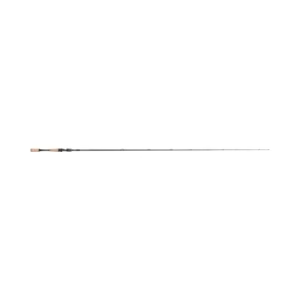
SHIMANO POISON GLORIOUS CASTING ROD
Price range: €468.08 through €494.09Select options This product has multiple variants. The options may be chosen on the product page
Reviews
There are no reviews yet.